


Page 55 - TFC 2022 Catalogue
P. 55
FAQ’s


           Approximate reduction in RF signal stength after passing through different materials
           Note: Large kitchen appliances or mirrors in the line-of-sight between Tx and Rx will weaken or bock signals


              Stud Partition         Glass             Brick & Morter       Re-inforced Wall   Solid Metallic Surface
                5 - 20%             10 - 30%             10 - 40%             40 - 80%             90 - 100%


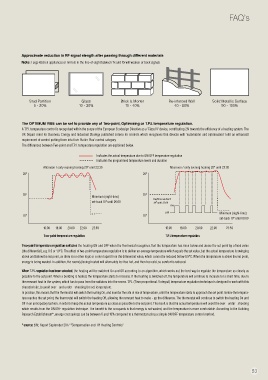
           The OPTIMUM VIBE can be set to provide any of Two-point, Optimising or T.P.I. temperature regulation.
           A T.P.I. temperature control is recognised within the scope of the European Ecodesign Directive as a ‘Class IV’ device, contributing 2% towards the efficiency of a heating system. The
           UK Depart-ment for Business, Energy and Industrial Strategy published criteria for controls which recognises that devices with ‘automation and optimisation’ fulfil an enhanced
           requirement of control putting them into their ‘Boiler Plus’ control category.
           The differences between Two-point and T.P.I. temperature regulation are explained below.

                                            Indicates the actual temperature due to ON/OFF temperature regulation
                                            Indicates the programmed temperature levels and duration

                    Afternoon / early evening heating 20º until 23:30        Afternoon / early evening heating 20º until 23:30


           20º                                                   20º


             15º                                                 15º
                                          Minimum (night-time)             -back

                                          set-back 10º until 06:00   14   0
                                                                             ON

                                                                          OFF                      Minimum (night-time)
             10º                                                 10º
                                                                                                   set-back 10º until 06:00

                    16:00    18:00    20:00    22:00    23:59             16:00  18:00    20:00   22:00  23:59
                    Two-point temperature regulation                       T.P.I. temperature regulation
           Two-point temperature regulation switches the heating ON and OFF when the thermostat recognises that the temperature has risen below and above the set point by a fixed value
           (the differential), e.g. 0.5 or 1.0ºC. The effect of two-point temperature regulation is to deliver an average temperature which equals the set value, but the actual temperature is swinging
           above and below the set point, as there is no other logic or control apart from the differential value, which cannot be reduced below 0.5ºC. When the temperature is above the set point,
           energy is being wasted. In addition, the room(s) being heated will alternately feel too hot, and then too cold, so comfort is reduced.
           When T.P.I. regulation has been selected, the heating will be switched On and Off according to an algorithm, which works out the best way to regulate the temperature as closely as
           possible to the set point. When a building is heated, the temperature starts to increase. If the heating is switched off, the temperature will continue to increase for a short time, due to
           the remnant heat in the system, which has to pass from the radiators into the rooms. T.P.I. (Time proportional / Integral) temperature regulation technique is designed to work with this
           characteristic, to avoid over - and under - shooting the set temperature.
           In practise, this means that the thermostat will switch the heating On, and monitor the rate of rise of temperature, until the temperature starts to approach the set point. Before the tempera-
           ture reaches the set point, the thermostat will switch the heating Off, allowing the remnant heat to make - up the difference. The thermostat will continue to switch the heating On and
           Off in an anticipatory fashion, in order to keep the actual temperature as close as possible to the set point. The result is that the actual temperature will avoid the over - under - shooting
           which results from the ON/OFF regulation technique. The benefit to the occupants is that energy is not wasted, and the temperature is more comfortable. According to the Building
           Research Establishment*, energy cost savings can be between 6 and 10% compared to a thermostat using a simple ON/OFF temperature control method.


           * source: BRE Report September 2017 “Compensation and TPI Heating Controls”


                                                                                                                 53

